
Blog · Decks
The best decking timber for the Northern Rivers climate
For most decks in the Northern Rivers, spotted gum and blackbutt are the best all-round choices. Both are rated Class 1 for durability above ground, resist termites, are very hard, and are approved bushfire-resisting timbers up to BAL-29. Ironbark is even tougher, merbau is a solid option with a couple of catches, and H3 treated pine suits budget decks and framing.
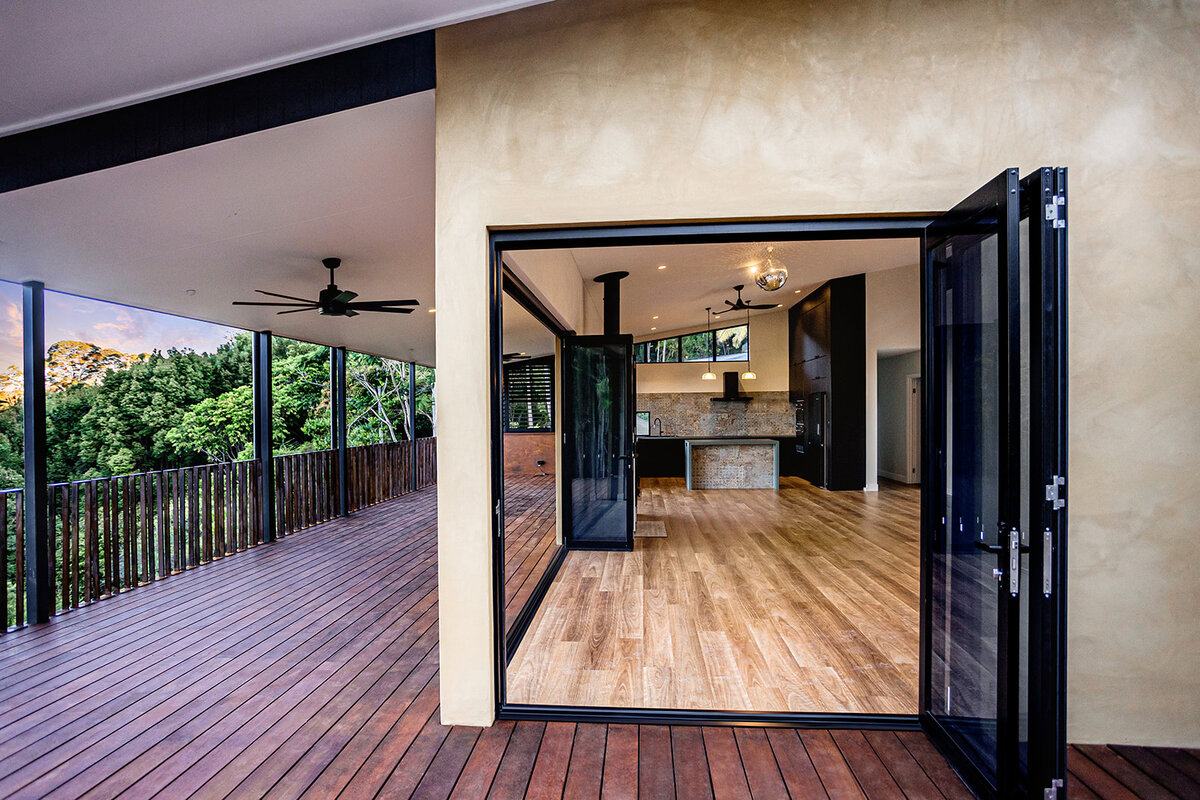
Why our climate is hard on decks
Decks around Byron Bay, Mullumbimby and the hinterland deal with high humidity, heavy summer rain, termites, strong sun and, near the coast, salt air. Many hinterland blocks are also bushfire-prone, which limits the timbers you can use. The right timber, fixings and spacing are what make a deck last here.
Decking timbers compared
| Timber | Durability above ground | Hardness | Bushfire use |
|---|---|---|---|
| Spotted gum | Class 1 | Very hard (10.1 kN) | Bushfire-resisting, up to BAL-29 |
| Blackbutt | Class 1 | Very hard (8.9 kN) | Bushfire-resisting, up to BAL-29 |
| Red ironbark | Class 1 | Very hard | Bushfire-resisting, up to BAL-29 |
| Grey ironbark | Class 1 | Extremely hard (16 kN) | Up to BAL-19 |
| Merbau (kwila) | Class 1 | Hard (8.5 kN) | Listed as bushfire-resisting, up to BAL-29 |
| Tallowwood | Class 1 | Hard | Up to BAL-19 |
| Treated pine (H3) | Treated, not natural | Soft | Not a bushfire-resisting timber |
Durability, hardness (Janka) and bushfire ratings from WoodSolutions Technical Design Guide 21 and WoodSolutions, Timber options in bushfire-prone areas. All the hardwoods listed are termite resistant.
Durability Class 1 means the timber should last more than 40 years above ground with good detailing and maintenance. For posts and framing close to the ground, ironbark and tallowwood (Class 1 in the ground) or H4 and H5 treated pine are the better picks.
The main options
Spotted gum
A local favourite for good reason. It's very hard, durable and low in tannin, so it won't stain your paving. Its colour ranges from pale grey-brown to deep brown, with a lovely wavy grain.
Blackbutt
Lighter and more even in colour, which suits the relaxed coastal look. It's just as durable as spotted gum above ground, but it can bleed tannin early on, so seal it well.
Ironbark
The toughest of the lot. Grey ironbark is extremely hard and Class 1 even in the ground, which makes it great for posts and stairs. It's heavy and harder to work than other hardwoods.
Merbau
Durable, hard and often cheaper than local hardwoods. In Byron Bay, merbau decking runs about $315 to $580 per m² built, against $370 to $630 for spotted gum. Two catches: it's high in tannin and will stain concrete and pavers below, and it's imported, mostly from South-East Asia and the Pacific, where some supply isn't well controlled. Ask for certified timber.
Treated pine
The budget option. Use H3 for decking boards and above-ground framing, and H4 or H5 for timber close to or in the ground. It's soft, needs regular oiling, and isn't a bushfire-resisting timber, so it's ruled out on many hinterland blocks.
Building in a bushfire zone
If your block has a bushfire attack level (BAL) rating, it sets which decking you can use under the Australian Standard AS 3959:
- BAL-LOW: no special requirements
- BAL-12.5 and BAL-19: a bushfire-resisting timber or another high-density hardwood
- BAL-29: bushfire-resisting species only, such as spotted gum, blackbutt, red ironbark or merbau
- BAL-40 and Flame Zone: non-combustible decking or a specially tested system
Guides differ on exactly which parts of a deck the BAL-12.5 and BAL-19 rules cover, so always follow your BAL certificate and your certifier. Also, in NSW a deck built without council approval on bushfire-prone land must be non-combustible if it's within 5 m of the house.
Fixings near the coast
Salt air eats cheap screws, which then leave black stains in the timber. Industry guidance says fixings within 1 km of the coast must be stainless steel, and electroplated or zinc-plated fixings aren't suitable for decks. Close to the beach, marine-grade 316 stainless is the safest choice.
Spacing and airflow in a humid climate
- Leave 3 to 4 mm between seasoned hardwood boards up to 90 mm wide, and 4 to 5 mm for wider boards.
- Decks less than 400 mm off the ground need extra ventilation, more durable framing and access for termite inspections.
- Keep post stirrups at least 75 mm above the ground or footing.
- Leave the sides of the deck open so air can move underneath.
- Keep the deck at least 25 mm off the house, or extend the termite barrier to it.
Source: WoodSolutions TDG 21, Domestic Timber Deck Design.
Decking timber FAQ
What is the best decking timber for a humid climate?
Spotted gum and blackbutt are the best all-round choices. Both are Class 1 durable above ground, termite resistant and very hard. Good spacing and airflow matter as much as the timber.
Is merbau good for decking?
Yes. It's Class 1 durable above ground and usually cheaper than local hardwoods, but it bleeds tannin that stains concrete and pavers, and you should ask for certified timber.
Can I use treated pine for a deck?
Yes, H3 treated pine is fine for decking boards on a budget. It needs regular oiling and isn't a bushfire-resisting timber, so it can't be used on many bushfire-prone blocks.
What decking can I use in a bushfire zone?
It depends on your BAL rating. Up to BAL-29, bushfire-resisting hardwoods like spotted gum, blackbutt, red ironbark and merbau can be used. BAL-40 and Flame Zone need non-combustible or specially tested decking.
What screws should I use for a deck near the beach?
Stainless steel. Fixings within 1 km of the coast must be stainless, and marine-grade 316 is the safest choice close to the beach.
Planning a deck?
Wise Build designs and builds hardwood and composite decks across Byron Bay, Mullumbimby and the Northern Rivers. Call Trent on 0488 551 377 or send us a message for an onsite quote.
Get a quoteRead next: How much does a deck cost in Byron Bay? · All blog posts